
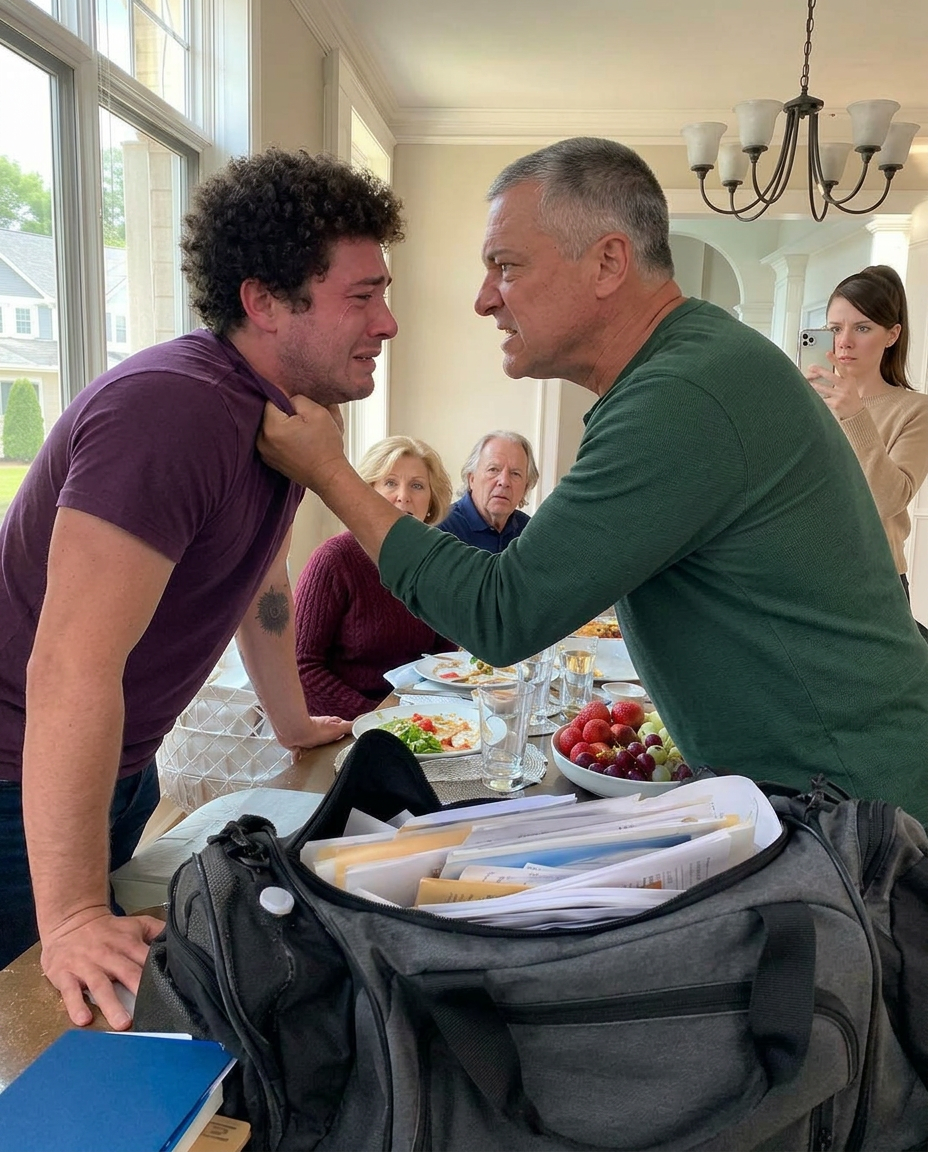
My father’s public decree brought family laughter, but my quiet “Alright” was a prelude to his next morning’s horror: an empty room and a lawyer’s trembling “Sir, what have you done?”


PART 1
I never revealed to my mother and father that the meager salary they constantly sought to manage was merely a fraction of what I’d secretly cultivated.
To Robert and Helen Thorne, I remained the reserved son, laboring excessively, conversing sparingly, and invariably coerced into funding whatever Clara desired subsequently.
They were aware of my employment. They were oblivious to my enterprise, my agreements, or the assets beyond their reach.
I swiftly realized any currency my relatives witnessed merely fueled their incessant demands for further contributions.
The weekly Sunday meal ought to have been reassuring. A succulent roast fowl occupied the table’s center. Rich gravy steamed alongside it. Iced sweet beverages dripped onto carefully folded linens.
Instead, the room felt heavy with old expectations.
In our family, the rules were simple. Clara wanted something. My parents supported her. I paid for it.
That had been true for years.
When Clara wanted expensive shoes, I was told she needed confidence. When she wanted a better phone, she needed opportunity. When she wanted money for another dream she would abandon three months later, I was reminded that family came first.
If I kept my money, I was selfish.
If I said no, I was cruel.
If I stayed quiet, I was arrogant.
Love in that house always came with a bill, and somehow my name was always on it.
Dad was charming in public. He shook hands at church, helped neighbors move furniture, and laughed loudly at community events.
At home, he was different.
His voice became sharp. Every room felt smaller when he was angry.
Mom rarely yelled. She didn’t need to. Helen Thorne could make someone feel guilty with a smile and a carefully chosen sentence.
Clara learned from both of them.
She never demanded.
She simply wanted something, and everyone else was expected to make it happen.
I was the practical son. The dependable one. The one expected to figure everything out.
When I landed my first full-time job after community college, I thought my parents might finally be proud.
Instead, Dad asked only one question.
“How much does it pay?”
That was the moment I started hiding things.
I told them less than the truth.
Then I opened separate accounts.
Took on side projects.
Learned software late at night.
One Tuesday at 11:38 p.m., sitting in my apartment building’s laundry room because the Wi-Fi upstairs kept failing, I registered my LLC.
The dryers rattled.
The fluorescent lights buzzed.
Someone had left a sock on top of a washer.
I remembered every detail because it was the first night my future felt like it belonged to me.
Over the next three years, I built quietly.
Contracts.
Invoices.
Property records.
Bank statements.
Proof.
Not because I wanted revenge.
Because I wanted protection.
When you grow up around people who rewrite history whenever it becomes inconvenient, documentation becomes survival.
My younger sister Lily understood that better than anyone.
She was quiet, observant, and smarter than people realized.
That Sunday afternoon, she sat on the couch near the window, sleeves pulled over her hands, watching everything.
PART 2
Clara arrived late, as usual.
She kissed Mom’s cheek, complimented the chicken, and sat down with the smile she always wore before asking for something expensive.
“I’ve been thinking,” she began.
That sentence always meant trouble.
She explained that she wanted to move to Los Angeles.
A fresh start.
A new opportunity.
A chance to finally reach her potential.
And naturally, she would need help.
Rent.
Deposits.
Moving costs.
A financial cushion.
She never mentioned my name.
She didn’t have to.
Dad looked at me.
Mom looked at me.
Eventually Clara did too.
I took a slow sip of sweet tea.
“You’re going to help your sister,” Dad said firmly. “That’s what family does.”
I looked at Clara.
She didn’t seem desperate.
She seemed entitled.
“I’m not funding her lifestyle,” I said.
The room instantly tightened.
Mom laughed first.
“Listen to him,” she said. “Acting like he has a choice.”
Dad pushed his chair back.
“You think you’re better than us because you have a paycheck?”
“No,” I replied calmly.
“I think it’s mine.”
That sentence changed everything.
Not the refusal.
Not the money.
The ownership.
Dad stood.
The room felt smaller.
“You need to remember who raised you.”
I reached into my bag.
Dad sneered.
“What’s that? Another excuse?”
Instead of answering, I pulled out a folded document and placed it on the table between Clara’s glass and the serving dish.
The paper looked ordinary.
Black text.
Official stamp.
Nothing dramatic.
Dad grabbed it and started reading.
At first, he looked annoyed.
Then confused.
Then silent.
Mom leaned closer.
Clara stopped talking.
Lily slowly stood from the couch.
Dad read the document again.
For the first time in my life, I watched fear replace certainty on his face.
The paper identified the legal owner of the property.
This house.
The house we were sitting in.
The house where every demand, every insult, and every obligation had shaped my childhood.
Six months earlier, I had quietly purchased it through my company.
Dad’s thumb stopped on the final line.
Owner of Record: Carter Property Holdings LLC.
My company.
My name.
My house.
The room went completely silent.
Mom picked up the paper and read it herself.
“You did this,” she said.
“I did.”
Clara stared at me.
“You own the house?”
“My company does,” I said. “And I own the company.”
Dad finally looked up.
“How?”
“You were behind on your mortgage,” I answered. “The property was listed privately. I made an offer through a broker. You accepted it.”
Mom’s face tightened.
“We never would have agreed if we knew.”
“I know.”
PART 3
The old rules no longer worked.
Dad’s anger had nowhere to go.
Mom’s manipulation had nowhere to land.
Clara’s expectations suddenly looked fragile.
“What do you want?” Mom asked.
I thought about it.
For years.
I didn’t want revenge.
I didn’t want them homeless.
I didn’t want them afraid.
I simply wanted boundaries.
“I want you to understand something,” I said.
Everyone looked at me.
“I built something real. Without your approval. Without your help. Without your money. Every time I tried to keep something for myself, someone reached for it. So I stopped asking permission.”
No one interrupted.
“You can stay here,” I continued. “I’m not throwing anyone out. But things are different now.”
Clara spoke quietly.
“What does that mean?”
“It means nobody gets to reach into my life and call it family duty anymore.”
I looked directly at Dad.
“And it means if anyone ever tries to intimidate me again, I have paperwork that says otherwise.”
The ceiling fan clicked overhead.
The chicken sat untouched.
The gravy had gone cold.
Lily walked over from the couch, pulled out the chair beside me, and sat down.
She didn’t say a word.
She didn’t have to.
Dad lowered his eyes.
Mom quietly reached for her tea.
Clara stared at the tablecloth.
I picked up my fork.
“The chicken’s getting cold,” I said.
Nobody laughed.
Eventually, Lily picked up her fork too.
That was it.
No dramatic apology.
No emotional reconciliation.
No grand speech.
Just a quiet shift in the balance of power.
For the first time in my life, I sat at that table knowing I didn’t owe anyone a piece of myself.
I hadn’t destroyed the family.
I hadn’t handed them control either.
I had done something they never expected.
I had built a door with my name on it.
And for the first time, I was the one deciding whether it stayed open.
The folder on my laptop still exists.
It’s still called Records.
But recently, I created a second folder.
I named it:
Next.