
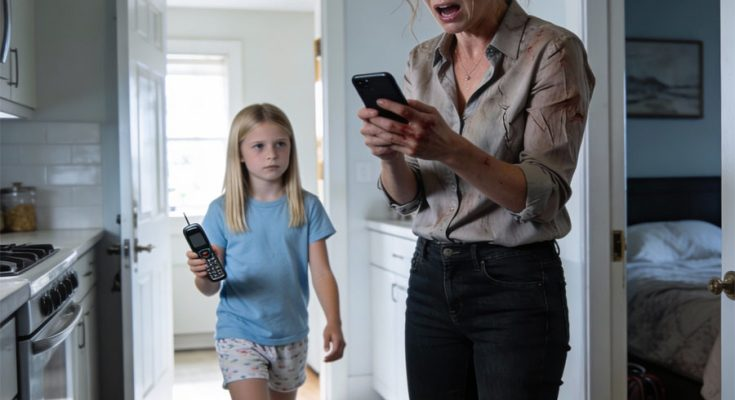
Sophia’s Brother Caleb Plundered Her Savings and Fled—Only For 10-Year-Old Daisy To Whisper: ‘Sophia, It’s Already Done’

My Brother Drained My Accounts and Vanished—Then My 10-Year-Old Daughter Calmly Declared, “Mom, I’ve Already Handled It”
My sibling, Caleb, had plundered my savings and vanished alongside his companion, Serena.
I was utterly crushed until my ten-year-old daughter, Daisy, reassured me, “Sophia, please don’t fret.
I’ve taken care of it.”
Forty-eight hours later, my brother, Caleb, telephoned me, his voice a furious bellow.
Initially, his words were an incomprehensible torrent of sound.
His voice fractured through the receiver, shrill and enraged, like a person fleeing a blaze, utterly terrified.
“What have you done, Sophia?” he shrieked.
“What have you done?”
I stood rooted in the kitchen, one hand clasped around a forgotten, now-cold coffee mug.
My daughter, Daisy, sat at the table, her breakfast untouched, brown hair dishevelled from sleep, backpack propped against her chair.
The moment Caleb’s name illuminated my screen, a chill permeated my entire being.
For two full days, I had dialled his number until my fingers ached.
I had messaged him, my hands trembling.
I had left voicemails that spiralled from desperate pleas to raw fury, then to a quiet, shattered despondency.
He had ignored every single communication.
Now, *he* was calling *me*.
And he was the one erupting in shouts.
“Caleb,” I managed, my voice barely holding steady, “where is my money?”
A sharp sound echoed on his end, as if a door had been violently shut.
Then Serena’s voice hissed from somewhere behind him, piercing and panicked.
“Don’t utter another word,” she snapped.
“Hang up now.”
But Caleb did not disconnect.
He exhaled raggedly into the receiver.
“You believe you’re so clever? Do you honestly think sending *that* stuff will intimidate me?”
My gaze flickered to Daisy.
She had become utterly motionless.
Her spoon remained suspended above her cereal bowl.
Her expression had shifted with that peculiar stillness children adopt when they sense adults are on the verge of uncovering a forbidden secret.
“What ‘stuff’?” I inquired.
Caleb emitted a harsh, bitter laugh, devoid of any genuine confidence.
It was merely fear attempting a façade.
“Don’t feign ignorance,” he snarled.
“The video.
The screenshots.
That location tracker.
Serena’s bank account is frozen, Sophia.
Frozen solid.
They even contacted her mother.
Her own mother.
Do you grasp the magnitude of what you’ve engineered?”
My fingers tightened on the countertop.
I hadn’t dispatched any video to anyone.
I hadn’t uncovered any screenshots.
I hadn’t caused anything to be frozen.
Across the kitchen, Daisy slowly, deliberately, lowered her spoon into the cereal.
“Sophia,” she murmured softly.
Caleb’s ear caught her voice through the phone.
For a fleeting half-second, he fell utterly silent.
Then he whispered, “Daisy?”
A quality in his tone sent an immediate shiver down my spine.
My daughter stared at the phone as though it were a venomous serpent coiled on the table.
Then, with quiet resolve, she lifted her chin.
“You shouldn’t have taken Mom’s money,” she said.
There are moments in a person’s life when everything slows down, not because time is kind, but because the truth is too heavy to arrive all at once.
That was one of them.
Before last spring, I thought my brother was careless, selfish, and irresponsible.
I did not think he was dangerous to me.
I did not think he could sit at my kitchen table, laugh with my child, drink my coffee, and count the days until he could clean me out.
Caleb had always been reckless.
Growing up, he was the kind of kid who broke windows and somehow convinced our mother the baseball had slipped out
of someone else’s hand.
He crashed cars, borrowed money, dodged rent, and loved people only as long as they were useful.
Still, he was my brother.
That sentence became the excuse I used for everything.
When he called me in March and said he had been laid off, I believed him.
When he said his landlord was “being insane” and gave him two weeks to leave, I let him move into the guest room.
When he said Serena had nowhere safe to stay either, I let her sleep on the pullout sofa for a weekend that became three weeks.
Daisy did not like Serena.
She never said it in a dramatic way.
Daisy was a careful child, observant in the quiet corners.
She noticed when people changed tone.
She noticed when adults smiled with their mouths but not their eyes.
One night, while I was washing dishes, she came beside me and whispered, “Does Uncle Caleb have to stay forever?”
I laughed because I thought she was being a child who wanted her space back.
“No, honey,” I said.
“He’s just getting back on his feet.”
Daisy looked toward the hallway where Caleb and Serena were whispering behind the guest room door.
“He doesn’t sound like he’s getting better,” she said.
“He sounds like he’s planning.”
I should have listened.
Instead, I dried my hands, kissed the top of her head, and told her not to worry.
The worst part is how normal the betrayal looked while it was happening.
Caleb bought groceries one afternoon and made a big show of leaving the receipt on the counter.
He fixed the loose handle on my pantry door.
He drove Daisy to soccer practice twice when I had late meetings.
He asked about my mortgage, my utilities, my savings, my old emergency fund.
|He made it sound like concern.
“You’ve always been good with money,” he said one evening, leaning against the fridge with a beer in his hand.
“I don’t know how you do it.”
I remember feeling proud in the smallest, saddest way.
As a single mother, I had built my stability dollar by dollar.
Every overtime shift, every packed lunch, every vacation I skipped, every sale rack sweater I bought instead of something new had gone into those accounts.
That money was not luxury.
It was safety.
It was rent if I got sick.
It was groceries if my hours got cut.
It was braces for Daisy one day, college applications later, a car repair without choosing between heat and food.
Caleb knew that.
And he took it anyway.
I had added him as a temporary authorized user because he said he wanted to contribute to shared expenses while staying at my house.
He told me his direct deposit was delayed and that using the same account for groceries and utilities would make things easier
It sounded inconvenient but reasonable.
The bank representative warned me that authorized access meant authorized actions.
I remember nodding impatiently, distracted by work emails and Daisy asking where her blue sweater was.
I did not hear the danger because the danger was wearing my brother’s face.
On the Monday morning I found the money gone, my first thought was that the app had glitched.
The number in checking was so low it looked absurd.
Like a typo.
Like a missing digit.
I refreshed the screen three times.
Then I opened savings.
The emergency fund was empty.
For a few seconds, I heard nothing.
Not the refrigerator hum.
Not Daisy in the bathroom brushing her teeth.
Not the neighbor’s dog barking outside.
Just a hollow rushing in my ears.
I called the bank with trembling hands.
The woman on the line was kind, but kindness did not put money back into an account.
“Ma’am,” she said gently, “the transfers were made by an authorized user.”
“Who?” I asked, even though I already knew.
There was a pause, then typing.
“Caleb Mitchell.”
I remember sitting down on the edge of my bed because my knees stopped trusting me.
He had moved the money in pieces, not all at once.
Late-night transfers.
Electronic payments.
Cash app transactions.
It had started three days earlier while I was in the same house, sleeping down the hall.
I called him.
Voicemail.
I called again.
Voicemail.
I texted, Caleb, call me now.
Then, What did you do?
Then, Please don’t do this.
Then, I am calling the police.
By noon, I walked into the guest room and found the closet empty.
The bed was stripped.
The drawer where Serena kept her curling iron was bare.
Caleb’s old hoodie, the one he always left on the chair, was gone too.
Only a faint smell of cologne remained.
That was what broke me.
Not the numbers on the screen.
Not the bank’s explanation.
Not even the silence after my calls.
It was the empty room.
The proof that he had packed calmly.
He had folded clothes while I made dinner.
He had carried bags out while Daisy slept.
He had left no note, no apology, no hesitation.
I sank onto the kitchen floor and cried so hard my ribs hurt.
Daisy found me there after school.
She stood in the doorway with her backpack still on, holding a permission slip in one hand.
Her face changed when she saw me.
I tried to wipe my cheeks quickly.
“I’m okay,” I lied.
She did not believe me.
Children may not understand adult finances, but they understand devastation.
They understand when the person who makes the world safe suddenly looks like she has nowhere to stand.
That night, I sat at the kitchen table surrounded by papers from the bank, police report notes, and a list of bills I no longer knew how to pay.
Daisy sat across from me, swinging her legs slowly, watching me with eyes too serious for ten.
Then she said it.
“Mom, don’t worry.
I took care of it.”
I looked up, exhausted.
“Honey, this is adult stuff.”
She nodded.
“I know.
That’s why I did what I did.”
At the time, I thought she meant she had prayed, or hidden her allowance for me, or made some small childlike plan that would break my heart if I asked too many questions.
I was too tired to ask.
For the next two days, my life became a blur of forms and phone calls.
The bank opened a review but warned me again that Caleb’s access complicated everything.
The police officer who took my statement looked sympathetic, but his questions were careful.
“You voluntarily gave him account access?”
“Temporarily,” I said.
“Was there anything in writing about what he could or couldn’t do?”
I stared at him.
There was not.
Because I had trusted him.
Because I had been stupid in the exact way loving people are stupid when someone they grew up with asks for help.
By Wednesday, I had barely slept.
I was sitting at the kitchen table, trying to decide which bill could survive being late, when Caleb called.
And now he was screaming about videos, screenshots, frozen accounts, and Serena’s mother.
“Put Mom on,” Daisy said suddenly.
I looked at her.
“What?”
My daughter swallowed.
Her face was pale, but her voice stayed steady.
“Put it on speaker.”
I should have said no.
I should have protected her from whatever this was.
But something had shifted.
Caleb’s panic, Daisy’s calm, the strange words coming through the phone, all of it told me my daughter had been carrying something alone.
I tapped speaker.
Caleb’s voice filled the kitchen.
“You little brat,” he snapped.
My heart turned to ice.
“Do not speak to my daughter like that,” I said.
He ignored me.
“You had no right to touch my stuff.”
Daisy’s lower lip trembled once.
Then she pressed it flat.
“You used my tablet,” she said.
“You said yours was dead.”
Serena cursed in the background.
Caleb went silent.
Daisy looked at me, then down at the table.
“He borrowed my tablet Saturday night,” she whispered.
“I was supposed to be asleep.
But I came downstairs because I wanted water, and I heard them talking in the guest room.
Serena said, ‘Once the transfer clears, we leave before Sophia wakes up.’”
The room seemed to tilt.
“Daisy,” I said carefully, “what did you do?”
She pulled her school backpack closer and unzipped the front pocket.
From inside, she took out her small blue tablet, the one with a cracked corner and stickers on the case.
“I forgot my tablet was still recording,” she said.
Caleb exploded.
“She’s lying! Sophia, she is lying! She’s a kid!”
But he sounded afraid.
Daisy opened the tablet with shaking fingers.
She tapped through a folder I had never seen before, then turned the screen toward me.
The first file was a video.
It had been recorded from a low angle, probably from the dresser in the guest room.
The image was partly blocked by a pile of clothes, but the sound was clear.
Serena’s voice came first.
“How much can you move before they flag it?”
Then Caleb.
“Enough.
She never checks at night.
She trusts me.”
I put one hand over my mouth.
On the phone, Caleb stopped breathing loudly.
Serena whispered, “Hang up.
Hang up now.”
The recording continued.
Serena said, “And your sister won’t call the cops?”
Caleb laughed.
That laugh was worse than any confession.
“Sophia? No.
She’ll cry first.
Then she’ll try to fix it quietly because she doesn’t want Daisy scared.
By the time she grows a spine, we’ll be gone.”
My eyes burned, but I did not cry.
Not then.
Something colder was building in me.
Daisy tapped another file.
This one was a screenshot.
Caleb had used her tablet to log into a ride-share account because his phone battery was low.