
Elara Vance’s Speeding Stop: Officer Harding Motioned Me Out After Her License Check

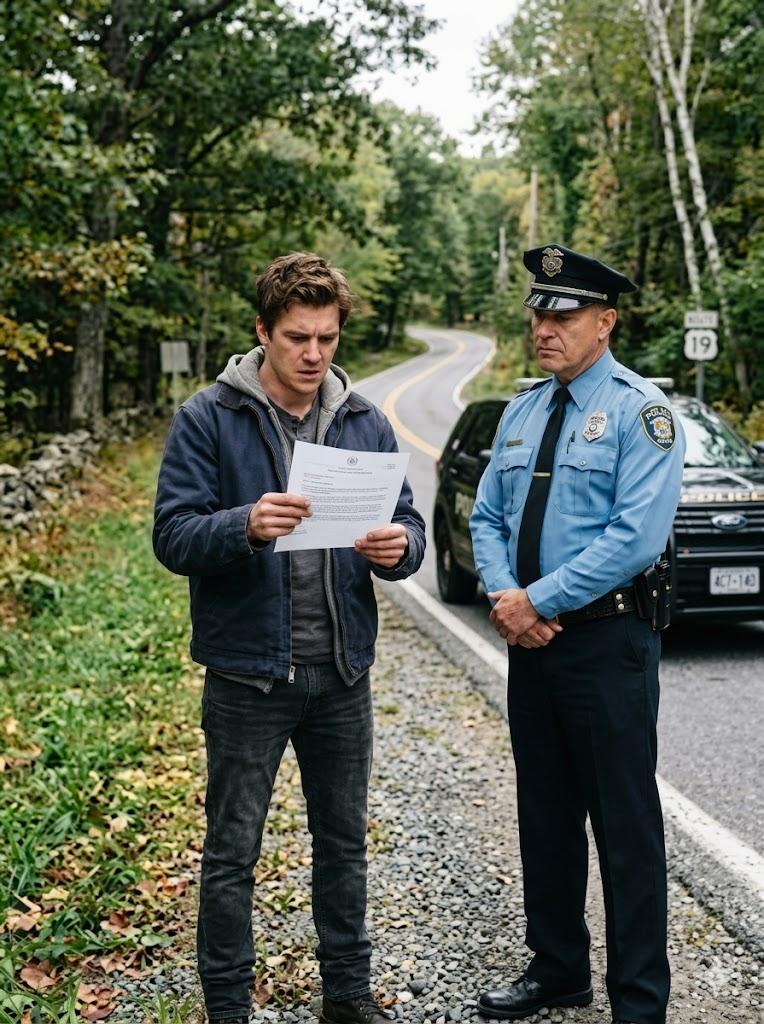
My spouse, Elara Vance, was pulled for speeding. After Officer Harding reviewed her license, he motioned for me to exit the vehicle. His expression grew grave. “Sir, listen closely. Do not return home tonight. Find a safe place.” I simply gaped. “What? Why?” He paused, then dropped his tone. “I can’t detail it now. But my discovery is grim. Extremely grim.” Then he pressed a note into my palm. Opening it, my entire existence shifted.
My spouse, Elara Vance, was pulled for speeding. After Officer Harding reviewed her license, he motioned for me to exit the vehicle. His expression grew grave. “Sir, listen closely. Do not return home tonight. Find a safe place.” I simply gaped. “What? Why?” He paused, then dropped his tone. “I can’t detail it now. But my discovery is grim. Extremely grim.” Then he pressed a note into my palm. Opening it, my entire existence shifted.
Part 1: The Traffic Stop
The patrol car’s lights drenched our Honda Civic in red and blue, transforming the interior into a flickering, aquatic chamber. It seemed a typical traffic stop, one that occurs daily on American highways, rarely evolving beyond a warning, a ticket, or an annoyed tale shared at dinner. My wife, Elara Vance, was cruising seventy-eight in a sixty-five on Route 35, not dangerously quick, but swift enough to catch the eye of a state trooper operating radar from an overpass as we drove toward her mother’s home in Millbrook on a drab Saturday afternoon. She offered her license and registration with the cool efficiency of someone previously stopped, always emerging with just a fine and a mild, disapproving lecture. When Officer Harding asked if she knew why he’d pulled her over, she gave him the slight, apologetic smile that once charmed me in a crowded Columbia coffee shop, back when we were younger and believed our lives would be built on honesty, because we intended to be honest people.
Officer Harding collected the documents and retreated to his patrol vehicle. I observed him via the rearview mirror, anticipating the customary brief interlude of data entry and anticipation, that minor bureaucratic delay separating annoyance from resumption. Instead, a subtle alteration in his bearing became apparent. He straightened his back. He hunched over the computer screen with an intensity unsuited for a standard speeding infraction. Moments elongated. Passing vehicles whispered by. Elara adjusted her mirror and flicked away an imaginary speck from her sleeve. When the officer emerged once more, he bypassed her side of the car. He approached mine, tapping softly on the passenger window.
“Sir, might I have a word with you in private?” he inquired.
His voice held no aggression. That fact intensified the unease.
I glanced at Elara. She looked confused, but not alarmed. I opened the door and followed him a short distance behind the car, far enough from the window that our voices would blur into the sound of passing traffic. The shoulder smelled faintly of hot asphalt and engine exhaust. The late sun pressed against the side of my face. Officer Harding turned toward me and held my gaze in a way that made my stomach tighten before he had said a word.
“Sir, I need you to listen carefully,” he said. “Do not go home tonight. Get somewhere safe. A hotel, a friend’s house, anywhere she doesn’t know about.”
For one second I honestly thought I had misheard him.
I stared at him, waiting for the sentence to rearrange itself into something reasonable. “What are you talking about? Is Elara in some kind of trouble?”
His jaw flexed. Instead of answering directly, he pulled a small folded sheet of paper from his shirt pocket and pressed it into my hand. “Read this later,” he said. “When you’re alone. And be very careful who you trust.”
I looked down at the paper, then back at him. “Officer, I don’t understand. We’ve been married ten years. We’re just driving to visit her mother.”
He lowered his voice further. “Your wife’s name triggered alerts in our system. Serious ones. I can’t explain everything here, but I’m telling you this because your safety may depend on it.”
I turned instinctively toward the car. Elara was sitting exactly where I had left her, one hand on the steering wheel, the other adjusting a strand of hair behind her ear. In the flashing lights from the cruiser, her face looked subtly different, sharpened somehow, less like the woman I knew and more like a version of her that had always existed just past the edge of my understanding. Officer Harding returned to the driver’s window, handed her license and registration back, and issued a standard verbal warning with the same professional calm he had shown from the start. Nothing in his manner suggested to her, or to anyone passing by, that he had just shattered the foundation of my life on the shoulder of a state highway.
We merged back into traffic. Elara was quiet the rest of the drive, quieter than a mere speeding stop should have made her. Her hands stayed a little too tight on the wheel. She checked the rearview mirror too often. When I asked if she was upset, she smiled and said no, but the smile passed over her face without touching anything underneath. I could feel the folded note in my pocket like a hot coin, impossible to ignore and impossible to explain.
By the time we reached her mother’s house, I had already started looking at my wife as if the edges of her had shifted and I was only just beginning to notice.
Part 2: Seven Words
Dinner at her mother’s passed with almost insulting normalcy. Elara laughed in the right places. She helped clear dishes. She listened with bright attention to the same family stories I had heard variations of for years. If there was danger anywhere in the room, it wore lipstick and passed the salad with perfect manners. Yet once suspicion enters a marriage, it changes the texture of everything. Elara’s laughter sounded a touch too crisp. Her warmth felt placed rather than spontaneous. She was not behaving oddly, exactly. She was behaving with the precision of someone who understood the value of seeming unremarkable.
We spent the night in the familiar guest room upstairs, the room with the floral curtains and the slightly overstuffed mattress and the framed watercolor of a harbor hanging crooked above the dresser. I waited until Elara’s breathing deepened and the darkness settled fully before slipping into the bathroom and locking the door behind me. I sat on the edge of the tub and unfolded the note beneath the glow of my phone.
Seven words were written in block letters on a torn piece of police notepad.
She isn’t who she says she is.
Beneath that was a phone number and one word.
Detective.
I read the sentence again and again, as if repetition might reveal some less catastrophic meaning hidden inside it. It never did. I stayed awake the rest of the night beside my sleeping wife, staring into the dark and letting memory rearrange itself under this new, impossible light. I thought about how little I actually knew of her work. She said she was in pharmaceutical marketing for a company called Meridian Pharmaceutical Marketing. I had never visited her office. I had never met a colleague. There had never been a holiday party, a company picnic, a casual dinner with coworkers. Whenever I asked about clients or campaigns, she answered in generalities polished enough to discourage follow-up. At the time, I had taken that as ordinary privacy, the kind even healthy marriages contain. In the dark of her mother’s guest room, it began to feel like architecture.
The next morning, once we were back home and Elara had left for what she described as a Saturday client meeting, I called the number.
The man who answered introduced himself as Detective Adam Reynolds, organized crime unit. The phrase alone was enough to make my hands go cold. I explained who I was and how I had gotten his number, and the line went quiet for a beat long enough to make me hear my own pulse in the kitchen. Then he asked me if I was alone, and when I said yes, he told me he needed me to listen very carefully.
“Your wife has been under surveillance for eight months,” he said. “She is a subject in an ongoing money-laundering investigation involving organized criminal networks moving millions through shell businesses and personal accounts.”
The room seemed to tilt.
“That’s impossible,” I said, but even to me it sounded thin. “She works in marketing. She travels for clients. She—”
“There is no registered company called Meridian Pharmaceutical Marketing,” he said gently. “We checked. The job is a cover. The laptop, the business cards, the travel schedule—props. Your marriage has been useful to her because it made her look stable, respectable, and less suspicious to banks and other institutions.”
I sat down hard at the kitchen table where Elara and I had spent years sharing coffee and grocery lists and ordinary little intimacies that now felt staged in retrospect. The coffee maker stood silent on the counter. Her mug was still in the sink. Somewhere beyond the window a leaf blower whined to life in a neighbor’s yard, absurdly normal against the collapse happening inside me.
“Are you telling me I’ve been used as camouflage?”
“I’m telling you your wife has been living two lives,” Reynolds said. “And the one she showed you appears to have been designed to support the one she kept hidden.”
Part 3: The Marriage as Cover
Once Detective Reynolds began asking questions, the shape of my own ignorance became humiliatingly clear. Had I ever visited her office? No. Had I met a supervisor? No. Had I seen tax documents that clearly verified her employer? Not really. Did she regularly take calls in other rooms? Yes. Did she travel with surprising frequency for a marketing role that seemed oddly vague in scope? Yes. Had she ever reacted with irritation when I asked too many follow-up questions? Also yes, though at the time I had filed that away under fatigue, work stress, adulthood, the thousand reasonable things people use to avoid confronting what would be unreasonable if it were true.
Reynolds laid it out in careful, measured terms. Elara had allegedly been working as a financial intermediary inside a laundering network, moving illegal proceeds through bank transfers, shell companies, and accounts built to look clean. Drug money. Gambling money. Protection money. Money that arrived filthy and needed someone smart, patient, and unremarkable enough to wash it into legitimacy. My wife had been that person. And according to the investigation, her marriage to me had been part of the design. Respectable husband, tidy life, predictable routine, suburban house, no drama. A perfect mask.
Then came the part that hollowed me out completely. Elara, he said, had likely been preparing to leave. They had evidence of funds being quietly rerouted, duplicate financial identities, contingency plans involving offshore accounts and possible relocation. She had not just lied to me about who she was. She had apparently been getting ready to strip what she could from our life and disappear.
The detective did not ask for my help immediately. He explained the risks first. If I wanted out, they would continue their case without me. But if I helped, if I agreed to document what happened inside my own home, they could move faster and make stronger arrests not only against Elara but against the wider network around her. There would be danger either way. If I did nothing, I remained in a house with a woman who had weaponized trust for a decade. If I cooperated, I would become a silent witness against the person I had loved most intimately in the world.
The choice, once stated that way, was not really a choice.
Over the next six weeks, I became a stranger in my own life. Reynolds and his team taught me how to install cameras disguised as ordinary electronics, how to copy files from Elara’s laptop, how to leave my phone recording in rooms where she took calls, how to look at the woman across the dinner table and keep my face composed while I slowly helped the government dismantle the world she had built beneath our marriage. It was not the technical part that nearly broke me. It was the acting. It was kissing her goodnight while knowing that earlier that afternoon I had watched video of her discussing cash movement in code with men whose names appeared in organized crime intelligence reports. It was listening to her complain about client deadlines while I held copies of account ledgers that proved she had been moving sums of money we had never earned. It was discovering, in hidden folders and private communications, that she had laughed at my ignorance. That she had referred to me not as a husband but as “cover.” That she had spoken of our shared life as one speaks of a hotel room—useful while occupied, not something to feel guilty about leaving behind.
I had once loved Elara with the uncomplicated confidence of a man who believed intimacy meant mutual exposure. Now I understood that I had been exposed while she remained professionally disguised, and that the imbalance of that arrangement had not been accidental. It had been the point.
PART4: My wife got pulled over for speeding, and after the officer checked her license, he asked me to step out of the car. His face turned serious. “Sir, you need to hear me carefully. Do not go home tonight. Go somewhere safe.” I just stared at him. “What? Why?” He hesitated, then lowered his voice. “I can’t explain it here. But what I found is bad. Very bad.” Then he slipped a note into my hand. When I opened it, my whole world changed.