
The $4,386 Lobster Gambit: Eleanor Vance’s Estranged Family Placed The Order, Her Father Demanded She Foot The Bill, But The Manager’s Revelation Unmasked A Deeper Plot.

Arriving home from a three-day work trip to Denver, I discovered a strange minivan occupying my driveway, collapsible patio chairs arranged on my porch, and muddy men’s utility boots next to my front entrance.
For a fleeting, absurd moment, I considered I’d somehow approached the incorrect dwelling — an illogical thought, given I’d poured seven grueling years into acquiring that pristine craftsman residence in Portland.
My name was Eleanor Vance. I was thirty-five years old, and each cabinet, every window frame, every rosebush adorning the path, had been financed through endless overtime, sacrificed holidays, and unwavering dedication.
Then I unlocked the front door and heard strangers laughing loudly in my living room.
An elderly couple I’d never encountered sat casually on my sofa watching television, while cardboard boxes littered my polished hardwood and my framed family pictures were piled against the wall.
My sister, Beatrice, emerged from the kitchen, dressed in my cardigan and clutching my coffee mug. She froze the instant her eyes met my suitcase.
“Oh,” she remarked nonchalantly, as if I had disturbed her hotel visit. “You’ve returned ahead of schedule.”
Before I could respond, my mother stepped out from behind her, stating, “Eleanor, please don’t complicate this. Your sister required stability, and her in-laws also needed a place to reside.”
I gazed past them into the dining room, where Beatrice’s father-in-law sat eating takeout at the table I had meticulously refinished with my own hands.
“What are these individuals doing inside my residence?” I questioned slowly.
Beatrice’s expression hardened instantly. “Mother clarified this property was essentially mine as well, because family shares.”
My mother moved nearer, dropping her voice as if I were the irrational party. “Sweetheart, your sister’s marriage is delicate currently. Simply vacate for a short period and allow her happiness.”
The whole room fell silent.
I looked at my mother. Then Beatrice. Then the unfamiliar faces already settling into the home I’d toiled years to acquire.
“Vacate?” I repeated. “From the property with my name on the legal deed?”
Beatrice rolled her eyes theatrically. “You’re constantly traveling regardless. You don’t even utilize all this space.”
Something within me snapped so subtly that no one perceived it.
I entered the guest room and found my apparel forced into trash bags, my office documents crammed into a closet, and Beatrice’s in-laws’ luggage splayed open across my bed.
I hauled the first suitcase outside and dropped it forcefully onto the porch.
Beatrice shrieked, “What are you doing?”
“Reclaiming stolen space,” I retorted.
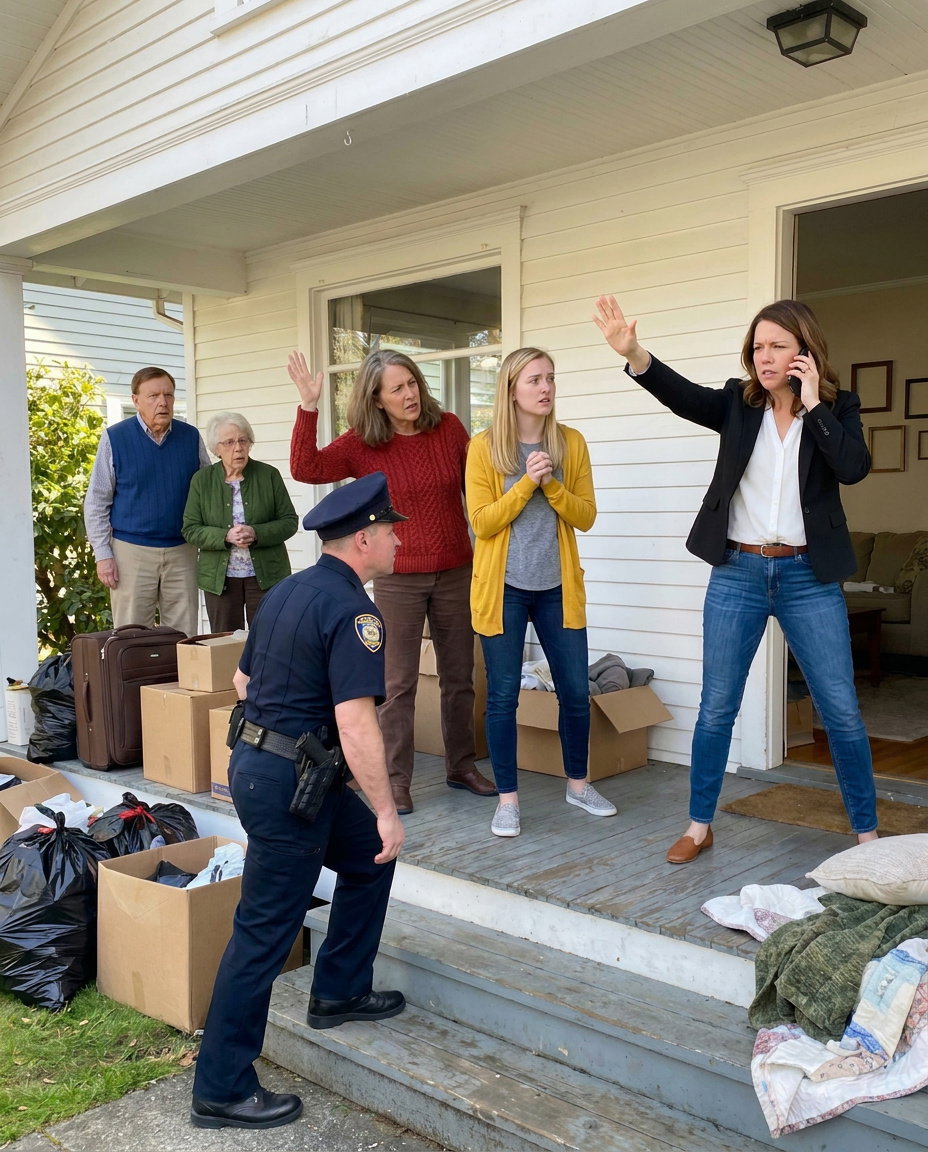
By the time I tossed the third bag onto the lawn, her mother-in-law was weeping, my mother was shouting, and Beatrice was threatening to dial the police.
I lifted my phone and stated, “Already taken care of.”
Then I dialed 911 and reported uninvited occupants within my home…
Part 2
The initial police officer arrived twelve minutes later, and a second patrol vehicle followed after the dispatcher overheard shouting during my phone call.
Beatrice rushed onto the porch before I could utter a word, pointing at me and shouting, “She’s unbalanced. She returned home and began throwing my family’s possessions outside.”
Officer Daniels glanced at the suitcases scattered across the lawn, then at me, then at the older couple standing behind Beatrice like displaced guests from a ruined vacation rental.
I handed him my driver’s license, the deed copy saved in my cloud storage, my latest mortgage statement, and the security camera alert showing Beatrice entering the house with a key two days earlier.
The officer asked who had authorized her to move people into the property.
My mother immediately answered, “I did.”
He turned toward her. “Do you own this house?”
Her face tightened instantly. “I’m her mother.”
“That’s not what I asked,” he replied.
Beatrice’s father-in-law, Frank, finally spoke from the doorway. “We were told Beatrice owned this place together with her sister.”
I looked directly at him. “She lied.”
Beatrice spun toward me angrily. “Don’t you dare humiliate me in front of my in-laws.”
“You humiliated yourself,” I said coldly. “You moved strangers into my bedroom while I was on a plane.”
Officer Daniels asked Beatrice whether she had ever legally lived there, paid rent, signed a lease, or received written permission to occupy the home.
The answer to every question was no.
My mother kept interrupting, insisting family arrangements worked differently, insisting I had always been difficult, insisting Beatrice needed support after an argument with her husband.
Then the officer asked Beatrice whether she had any proof of ownership.
She produced a printed email she had sent to her in-laws describing the house as “our family property” and promising I would “transfer the arrangement later.”
The officer read it twice carefully.
“That is not proof,” he said finally. “That is a statement you wrote.”
My anger turned colder the moment I realized this had never been a misunderstanding.
Beatrice had deliberately presented my home as hers, moved her husband’s parents into it, and expected me to surrender because making a scene would be too ugly to fight.
The officers ordered everyone without permission to leave immediately.
That was when Beatrice began crying — loud, sharp, theatrical tears — screaming that I was ruining her marriage.
Her mother-in-law sobbed that they had nowhere else to stay.
My mother grabbed my arm tightly and hissed, “Eleanor, stop this before you shame all of us.”
I pulled my arm away and said, “You should’ve thought about shame before asking me to move out of my own house.”
The officers escorted them away from the doorway while I stood barefoot on my porch watching every box return to the driveway.
Part 3
That night, after the police finally left, I changed every lock, reset the garage code, and sat alone in my kitchen surrounded by scratches across the floor where strangers had dragged furniture through my life.
I barely slept.
Every creak in the house made me imagine Beatrice returning with another lie, another copied key, another audience ready to paint me as cruel.
The following morning, I called a real estate attorney named Karen Holt and emailed her the police report, the security footage, and photographs of the damage.
Karen listened quietly without interrupting. Then she said, “Your sister didn’t just cross boundaries. She created a false housing claim using your property.”
By noon, Karen had drafted a formal trespass notice for Beatrice, my mother, and both in-laws, warning them not to return without written authorization.
My mother called thirty-seven times before finally leaving a voicemail that started with crying and ended with, “You chose walls over blood.”
I saved the message.
Then I sent her a single text.
“No, Mom. You chose Beatrice’s lie over my home.”
Beatrice’s husband, Aaron, called later that afternoon sounding exhausted and embarrassed.
He admitted Beatrice had told him I offered the house because I was “never home anyway,” and that his parents had already sold their short-term rental furniture expecting to stay for several months.
“I didn’t know,” he said quietly. “But I should’ve asked you myself.”
That was the first honest sentence anyone on their side had spoken.
I told him I was sorry his parents had been dragged into Beatrice’s deception, but they still were not welcome back onto my property.
Over the following week, relatives split into two groups: people who claimed I had overreacted, and people who suddenly remembered Beatrice had lied before about money, jobs, and favors.
My aunt Diane called and said, “Your mother has spent years protecting Beatrice from consequences and calling it love.”
I walked through the guest room while she spoke, picking up broken hangers, missing files, and one framed photograph Beatrice had shoved beneath the bed.
The house no longer felt untouched, but it still felt like mine.
Karen helped me file a small civil claim for damages, and Beatrice eventually paid after Aaron refused to cover the cost for her.
My mother didn’t apologize for months, but she stopped referring to the house as “family property.”
That alone told me she finally understood.
Beatrice moved into a rental apartment with Aaron and his parents after discovering that pretending ownership does not create a legal deed.
I repainted the guest room, bought a new lockbox for important documents, and never again handed out a spare key to anyone who believed love automatically meant access.
The first peaceful Sunday after everything ended, I made coffee in my own mug and sat alone on my own porch.
The lawn was empty. The driveway was clear. And nobody was laughing inside my house except me.
Because the day my family told me to move out so my sister could be happy, they forgot one very important thing.
Happiness built inside someone else’s home can still be carried out by the police.