
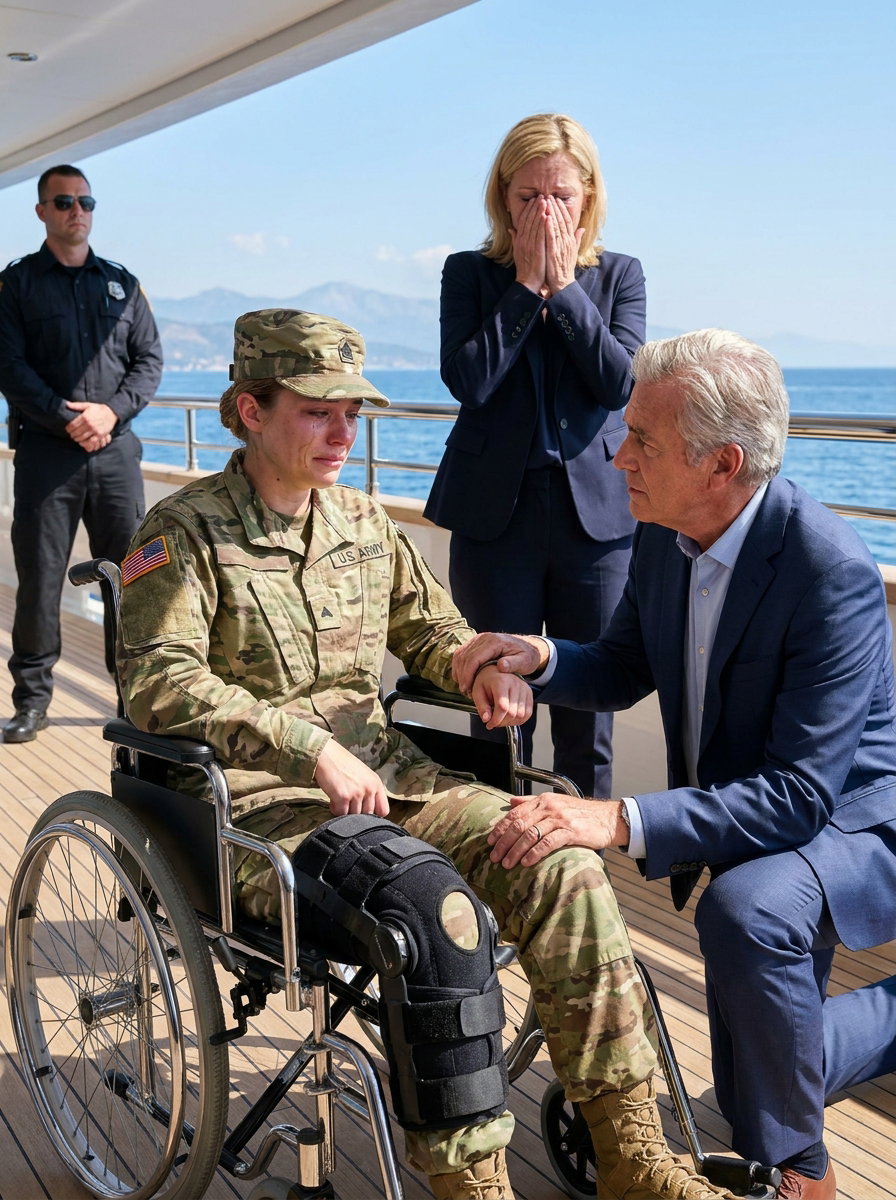
Arthur’s father spurned his disabled son, then partied over a mortgage Arthur secretly settled, until a bank call exposed the truth: Arthur owned the house, and his father had one hour to leave.

Chapter 1: The Threshold of Rejection
My name is Arthur Finch. I was thirty-two the afternoon my father violently shut the massive oak door on me, and had anyone suggested even a month prior that I’d survive a harrowing overseas deployment only to be barred from my childhood home like an unwelcome intruder, I would have dismissed them as mad.
The very first words my father uttered were not a warm, expected welcome home.
Instead, he stated, “We do not operate a nursing home here, Arthur.”
He occupied the doorway, a can of tepid beer in one hand, his hulking, imposing frame filling the entrance like a jagged barricade against the world. He wore the same faded blue flannel shirts he’d favored throughout my entire childhood, the same heavy work boots, and that familiar expression always combining deep irritation with a pathetic self-pity, as though others’ basic human needs were personal attacks on his own comfort.
A steady, gray drizzle, characteristic of the Oregon coast, had started, rendering the driveway slick and dark, while the taxi idled behind me at the curb, its exhaust hovering low over the damp pavement. I’d already propelled myself up the steep incline, my palms raw from gripping the rims and my shoulders throbbing with a dull ache from the concrete’s relentless slope.
This was the identical driveway I’d once shoveled as a young boy each winter before school, when my legs moved flawlessly and my greatest concern in life was simply completing geometry homework.
Now, I sat in my dress blues, medals gleaming and precisely aligned, the stiff, formal fabric draped over a body that had yet to fully grasp its own new, delicate geometry. My wheelchair rested on the porch boards I’d paid to have refinished just three summers prior.
The house behind him carried the identical scent, even from the threshold: a blend of lemon polish, stale cigarette smoke, aged carpet, and something deep-fried in excessive oil. For one fleeting, humiliating second, a naive part of me had envisioned a banner, a heartfelt hug, or at least the clumsy formality of a family struggling to show affection.
Instead, my father’s eyes fixed solely on the vacant space where my legs once were. His stare lingered for a long moment, his features hardening not from sorrow or compassion, but from a cold, biting sense of sheer inconvenience.
“Go to the military hospital in town,” he stated with a wave of dismissal. “We simply do not have the room for cripples in this house.”
He remained oblivious that the roof above his head and the solid floors beneath his boots were funded by the combat deployment money, the reenlistment bonuses, the disability backpay, and the injury settlement I had meticulously channeled home for years, all while he griped about mortgage payments and enacted the martyr in his own kitchen.
“Dad, it is me, your son,” I said, forcing my voice to remain steady through the phantom pain that had started up in my missing left calf like live wires buzzing under skin that no longer existed. “I am finally back home, and I tried calling you so many times from the transit base.”
He took a long swallow of his beer and leaned harder into the doorframe, blocking my view. “I see that you are back, and I see the chair you are sitting in. I already told your mother that I am not turning this beautiful place into a medical facility for your sake.”
“People like me?” I asked, trying to process his words when he claimed the hospital had beds for people like me. My voice shook, but not from fear, rather from a rising tide of shock, nausea, and something much darker beginning to churn underneath. “I am your own flesh and blood, Dad.”
“You are a burden, Arthur,” he said, with the flat, jagged practicality that men like him often mistake for honesty. “I am not interested in changing adult diapers at my age, and we have finally gotten this place looking exactly how we want it to look, so turn your chair around and go find somewhere else to waste your time.”
The cruelty of his tone was not theatrical at all, and that was exactly what made it feel so much worse. He spoke about me the way a man talks about a busted, outdated washing machine, feeling regretful only insofar as something broken might become an expensive repair.
I looked past him into the familiar hallway, catching a glimpse of a welcome home sign taped to the mirror, and for half a heartbeat my chest leapt before I saw the large, plush dog bed beneath it and realized the truth. The celebration was not for me, but for the new puppy my sister had been begging for all winter.
Then my sister, Mallory, appeared behind him, twenty two and glossy and beautiful in the high maintenance way that required significant money, effort, and the firm, unwavering belief that the world should organize itself entirely around her convenience. She had a cold iced coffee in one hand and a look of pure disdain already arranged across her youthful face.
She looked at my wheelchair, then looked at me, and wrinkled her nose in disgust.
“Are you being serious right now?” she said, laughing a sharp, brittle laugh. “I literally just redid your old room into a walk in closet for my shoes, and the lighting in there is absolutely amazing. Where on earth were you planning to sleep, the hallway?”
For a second, I thought I must have heard her wrong, as if the reality of the situation were slipping through my fingers. My room, the room with my old baseball trophies, the vintage model planes, and the cheap wooden desk where I had filled out my enlistment paperwork at seventeen, keeping it hidden from Dad for three days because I knew he would claim I was just doing it for attention.
“My room?” I repeated, my voice barely a whisper.
“Well, you were not using it for the last five years, were you?” she said, inspecting her perfectly manicured nails as if we were casually discussing the purchase of new throw pillows. “And honestly, those rubber wheels are going to destroy the hardwood floors if you come inside.”
Before I could answer her, something small shot between my father and the doorframe. It was my ten year old brother, Sammy. He was skinny, bright eyed, and clutching the faded superhero blanket I had mailed him from the base in Europe because he once told me over a shaky video chat that it helped him sleep whenever the heavy thunderstorms rolled through the valley.
“Arthur!” he shouted, his whole face lighting up with a kind of pure, unadulterated love that adults often lose the ability to feel cleanly. He started running toward me, but Dad caught him by the back of his shirt and yanked him backward hard enough to make the small boy stumble.
“He can stay with me, Dad!” Sammy yelled, fighting desperately against his father’s grip. “I have a bunk bed in my room and he can take the top bunk, please!”
Mallory snorted loudly. “He cannot climb up to the top bunk, you absolute idiot.”
“Then he can have the bottom bunk and I will sleep on the floor!” Sammy shouted, tears already gathering in his wide, frantic eyes. “Please, Dad, let him stay!”
“That is enough out of you!” My father slammed his free hand against the doorframe, and the glass rattled in its casing. “You are embarrassing us in front of the neighbors, so get off this porch right now, Arthur. Go stay at that cheap motel on Route 9, and we will talk next week, maybe.”
Then he stepped back into the shadows of the house.
He looked at me one last time, not with a flicker of regret or even real, burning anger, but with the hollow expression of a man simply annoyed that a persistent problem had shown up in person. Then, he shut the heavy door.
The lock clicked with a metallic finality that rang out in the wet air like a gunshot.
I sat there in the cold rain for a few seconds after he closed the door, watching the water run down the back of my neck and soak into the collar of my dress uniform. I looked at the porch I had sanded and repainted for him three summers earlier, and I looked at the flowerbeds I had paid to have professionally landscaped because Mom once mentioned she missed having something pretty to look at when Dad came home drunk and loud.
I looked down at the folded bank letter in the inside pocket of my jacket, the surprise I had carried all the way home from my final tour. I had planned to put it on the dinner table that night and tell them the mortgage was gone, that the house was theirs free and clear, and that Frank Thorneley could finally retire from blaming the world for the life he had built so poorly.
Instead, I touched the edge of the paper and felt it become something else in my mind, not a gift, but a weapon.
I turned the chair around and rolled back down the slick driveway, the wheels hissing against the wet concrete. By the time I reached the taxi, the driver had the kind of careful, guarded pity on his face that people usually save for funerals and hospital waiting rooms.
“Where to, soldier?” he asked quietly, glancing at me through the rearview mirror.
I folded the chair into the trunk with hands that shook from a combination of adrenaline, cold, and a rising fury, and said, “Take me to the motel on Route 9.”
Then I pulled out my phone and added, “And please pass me that local phone book from up front, would you? I need the number for the foreclosure department at the First National bank office.”
Chapter 2: The Price of Clarity
Three days later, the rain had stopped, but the weather was the least significant storm brewing in town.
The motel room smelled strongly of mildew and harsh industrial cleanser. The wallpaper was peeling at one seam near the vibrating air conditioner, and the buzzing neon vacancy sign outside threw a rhythmic pulse of red light through the thin curtains every few seconds that made it impossible to forget exactly where I was.
A microwave lasagna sat completely untouched on the little laminate table. Beside it was a stack of legal documents thick enough to stun a horse, as I had spent the past seventy two hours in constant motion.
I had been through title searches, wire authorizations, verification calls, signatures, notaries, and dozens of bank officers, including one legal clerk who looked at my wheelchair and then at the six figure transfer amount and visibly decided I was far above her pay grade emotionally.
My phone buzzed with a short text message from Sammy.
Dad and Mallory are screaming happy screams right now because they got a letter from the bank, and Dad says we are finally rich.
I closed my eyes and saw the scene immediately in my mind.
Frank would be standing in the center of the kitchen holding the letter from the bank, the one stating the mortgage had been satisfied in full. He would stare at that zero balance and instantly invent a reason it belonged to him, perhaps believing it was a payout, a bank error, or justice finally finding the little guy after years of his own laziness and bad luck, because in his mind the world always owed him compensation for the simple effort of existing.
Mallory would already be halfway to planning her next spree in her head, thinking about designer bags, a massive television, or the next visible status symbol that let her perform success while contributing absolutely nothing to its actual cost.
They would mistake my relief for their own ownership.